Artists
Carles Camps Mundó
(1948)
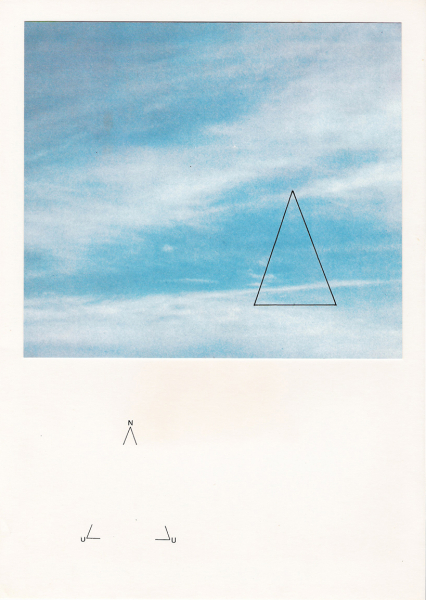
A Catalan poet, he became interested in experimental poetry at an early age and championed the path opened up by the surrealists, J.V. Foix and J. Brossa. As a result of this interest, he turned to visual poetry. The book La Nuu. Cuentos del horizonte (La Nuu. Tales from the Horizon) was published by Llibres del Mall, a highly important publishing house in Catalan culture, in 1974.
Visual poetry is an experimental form in which the image, the plastic element, in all its facets, techniques and media, predominates over the other components. This form of non-verbal poetry constitutes a genre in its own right, and in the field of experimentation, its creators move along the border between genres and arts, such as painting, poetic action, theatre, music and discursive lyricism itself, giving rise to various forms of poetics: visual poetry (concretism, lettrism, semiotics, poetry and poetry) action poem.
Nuu, a feminine word used in poetic Catalan meaning cloud, gives its title to a series of visual poems by Mundó in which, in a peculiar ars combinatoria, he cuts and fragments photographs of cloudy skies into different geometric shapes and typographical games with the dance of the letters that make up the word. A poetic creation based on visual resources that straddles the boundary between painting, photography, collage, design and writing. A heterogeneous screen, a two-dimensional box where all language is welcome in favour of the creative gaze.
In 1981, he exhibited all his visual poetry at the Fundació Miró and published the series La columna. It was from this decade onwards that he devoted himself to discursive poetry, offering an in-depth analysis of fundamental themes of life, such as time, death, desire, memory and the function of words, with titles such as El contorno de la sombra (The Outline of the Shadow) and La muerte y la palabra (Death and the Word) (2010, Carles Riba Poetry Prize 2009).
If the name of the festival included the word from his series, with the recovery of this work, La Nuu wishes to pay tribute to this important visual and textual poet.
Cecília Coca
(Spain, 1998)
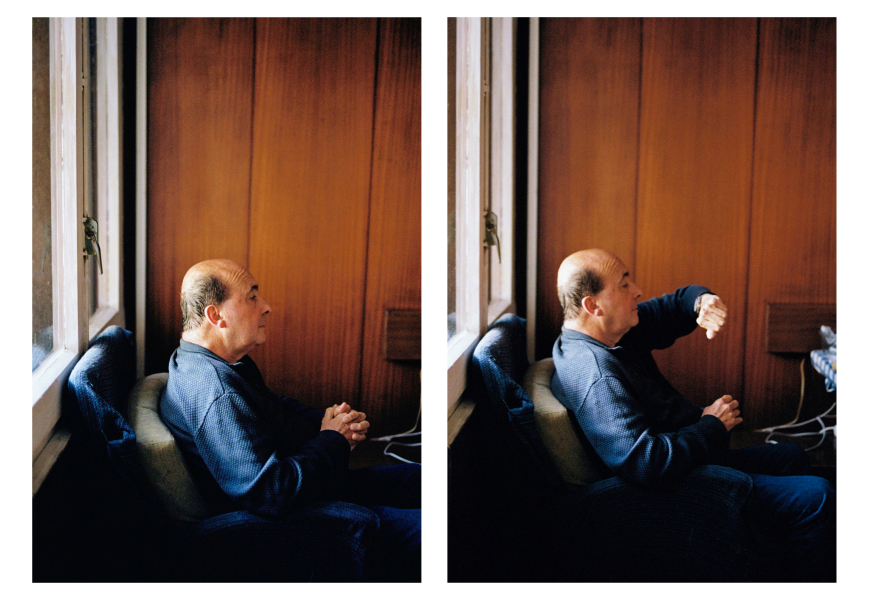
Mas Adei is a visual essay that explores the lifestyle of Leandro, the author's uncle. Like a field notebook, the camera records regular visits to his home over more than three years.
The work stems from a fascination with everything surrounding her uncle, a world of repetitive routines anchored in the past, inside an increasingly dilapidated house. Leandro, a special person who has always needed family support—first from his mother and now from his older sister, Montse—lives a life marked by strict rituals: at 4 p.m., listening to a zarzuela record; at 5 p.m., playing Parcheesi; at 6 p.m., going for a walk; and at 7 p.m., writing letters and organising his postcard collection. A man who seems to live between the 20th and 21st centuries.
Unconsciously, the photographer's gaze has adapted to the routines of the house, developing its own habits and visual fixations, capturing details that the human eye does not perceive and revealing the uniqueness of this time. Rather than documenting Leandro's life, Mas Adei seeks to observe the relationship between him, the space, the objects and the gestures that define this unique way of being in the world.
Photography seems to stop time. It freezes images in an eternal instant that reminds us of ‘this has been’. We take a photograph and what we have captured is already in the past. The relationship between still images and time is much more complex than it may seem at first glance. A sequence of still images creates a timeline. A before, a now and an after.
Documenting the same scene over the years reminds us of the passing of time. Repeating the same routine day after day does not stop time, but it does give it a certain meaning. Is a photograph a memory or the memory of a memory? Is a memory something we have or something we have lost?
Do we own the things we have photographed? Do we own the infinite images on the ubiquitous screens that we consume blindly and routinely every day?
Xavi Bou
(Spain, 1979)
Watching birds fly is like looking into the future and, in a way, also into the past.
In ancient Rome, omens were signs from the gods, interpreted by an augur, a priest who practised divination. The word “auspicius” is derived from Latin, composed of “avis”, meaning bird, and the verb “spicio”, meaning to see or look. Hence auspex, literally “one who looks at birds”, a practice in Greco-Roman religion consisting of observing the behaviour of birds to receive omens. The augur, dressed in the toga auguralis or travea, indicated that he would exercise his ministry and, to make his observations, climbed to the top of the auguraculum: then he would turn towards the East, point with the lituus, a curved staff, at the templum, a part of the sky divided into four quadrangular parts (today we would say four screens), and begin to carefully observe the birds that appeared, the way they flew, their songs, and towards which side of the templum they directed their flight, their speed and trajectory.
Augurs could not know the future, but they were able to discern, through auspices, whether a human act was in accordance with the divine will or not.
Xavi Bou is a contemporary augur who specialises in chronophotography and, more specifically, ornithography.
Chronophotography is an old photographic technique from the Victorian era that captures and prints movement in several frames. These prints can then be organised as celluloid animations or layered into a single frame. To do this, he uses a series of different cameras, originally created and used for the scientific study of movement, but which are now considered the predecessors of cinematography and motion pictures. Edward James Muggeridge was one of its pioneers.
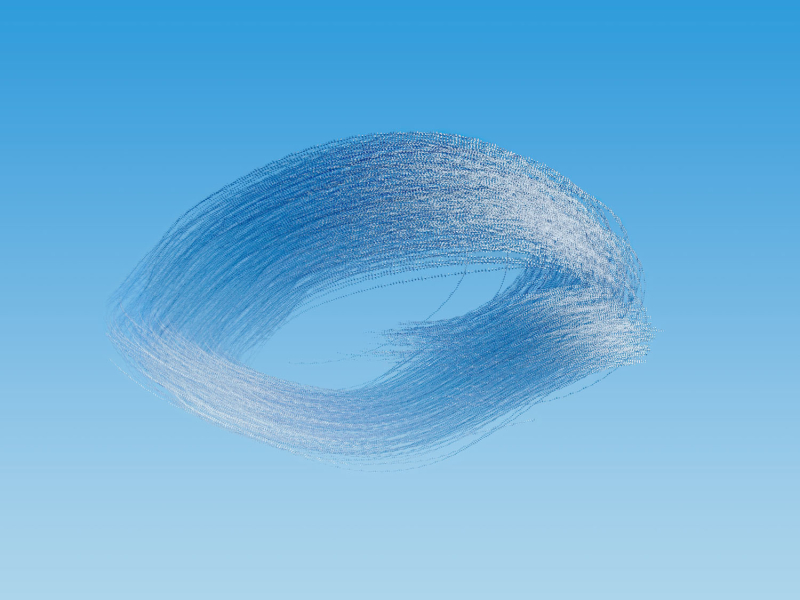
As a photographer, Xavi Bou has created Ornitographies, images that capture the flight path of birds using the technique of chronophotography to document the movement and pattern of their dance in the sky by superimposing different frames.
Interestingly, to perfect his technique and his photographs, he uses high-speed film cameras that can capture 60 to 90 high-resolution photographs per second. The resulting works are tangible examples of the balance between art and science.
Bou's purpose is to use visual poetry to spread awareness of the importance of caring for the environment, inviting viewers to perceive the world with the same curious and innocent gaze of the children we once were. The approach Bou uses to create the scenes in his Ornitographies is non-invasive. In fact, he rejects distant study, resulting in images of organic forms that stimulate the imagination.
His photographs capture the flight of a wide variety of birds in different parts of the country and abroad. His gaze manages to trace that invisible trail in the human eye that birds create as they fly through the sky.
Joan Teixidor
(Spain, 1977)
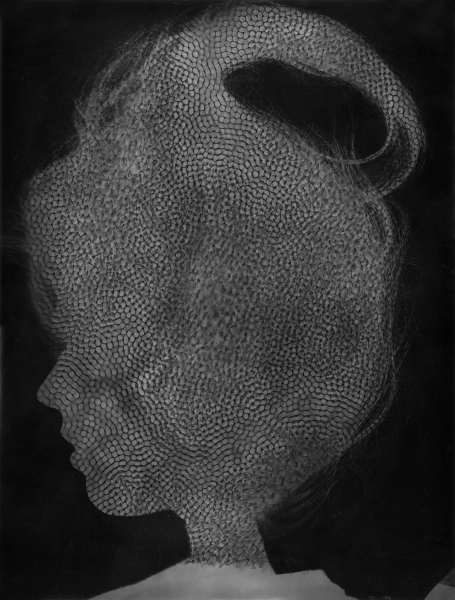
A black mirror (or Claude mirror) is a small, slightly convex mirror with a tinted surface. These mirrors, kept in small boxes or cases, were used by artists, landscape painters, travellers, and landscape enthusiasts. Their curvature produced the effect of abstracting the portion of the landscape that one wanted to see from everything around it, reducing the scale of the view, and the tint (which was usually sepia or brown) simplified the colour and tonal range of the scene. These instruments were widely used by English landscape painters in the late 18th and early 19th centuries as a method for making sketches and colour notes of the landscapes they would later paint. Those who used them adopted a very characteristic posture, as they had to turn their backs to the actual landscape in order to see the image reflected in the mirror as if it were a pre-photographic lens. In Jesús Ferrero's novel El efecto Doppler, a character explains to the protagonist, Darío Dolfos, that Impressionist painters also used them to rest their eyes, exhausted from so much contemplation and study of light. Closing your eyes to see better.
Opacidades by Joan Teixidor is made up of different photograms, that is, photographic images obtained by placing objects on a photosensitive surface and exposing them to direct light without the use of a camera.
The objects on display here are opaque, but reflective like a black mirror. They do not have the seductive power of contemporary brightness, nor its ubiquity, nor are they visible by backlighting. On the contrary, they are made of light fixed on a sensitive surface. Solid images as opposed to the liquidity of screen images. Time images.
Cristobal Ascencio
(Mexico, 1988)
The landscape exists in nature, but it is not nature. It is the result of the human gaze on the world and our need to segment reality. It is a hybrid object made up of the physical world and cultural construction. We tend to forget that it is human collectives that build the landscape by projecting their way of perceiving and feeling the environment.
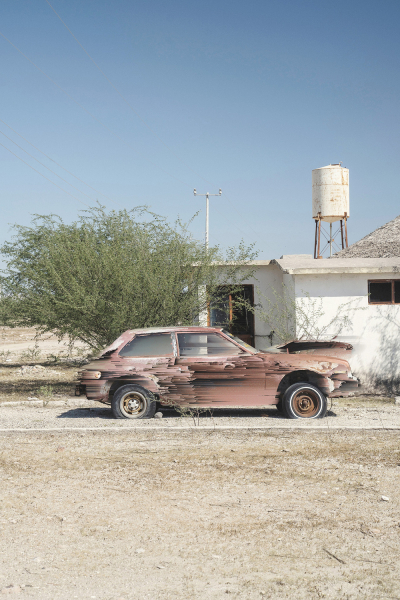
Instant Fossils by Cristóbal Ascencio is a photographic project that explores the landscape and human traces in the desert of Baja California Sur, Mexico. By manipulating the structural data of the images, abandoned objects and constructions in unpopulated places are intervened.
Fossils are the remains or evidence of the activity of past organisms. Fossils are important because they help us understand the history of life on Earth, the evolution of species, and environmental changes over time. Every image, no matter how abstract, is also a document, and since its inception, photography has served as a testimony to human activity and the preservation of the past. This project highlights the tension between various concepts that we can only understand through their interrelation. Whether this is due to their complementarity or their opposition: the passage of time-the furrow of the moment, technology-nature, human beings-the environment, or reality-mimesis, among others.
These images become ‘instant fossils’ when they lose their original purpose, transforming into new elements of the landscape and local geology. Using a programming code to reorganise pixels, the object or human footprint is visually modified and ‘reintegrated’ with the rest of the landscape.
The series distances itself from the romantic vision of the landscape, delving into post-natural environments as a new reality. From these transformed landscapes, a renewed relationship with our surroundings is proposed and the global impact of human activities on terrestrial ecosystems is re-examined.
Recognising these new environments allows us to rethink our relationship with the processes, materials, temporality and perception of landscape and ‘nature’.
Amandine Kuhlmann
(France, 1992)
A selfie is a photographic self-portrait taken with a mobile phone equipped with a camera to be immediately shared on the internet. Until recently, the power of self-representation was a prerogative limited to artists who had mastery of the technical materials and distribution channels for capturing and distributing images of themselves. With the democratisation of photography and the emergence of the virtual space of the internet, self-portraiture and self-expression are now within everyone's reach.
The selfie as a genre was created by teenage girls who were demanding a space to express their anxieties and desires. This type of image has quickly become common practice among all teenagers, but has also become widespread among adults as a new social ritual. The fundamental characteristic of selfies is that they are a more banal and, above all, more self-indulgent form of self-representation than the usual photographic self-portrait. They seem to be more linked to the state of the moment than to the essence, more to emotion than to feeling.
The democratisation of image production and access to the internet makes it easy for social media users to share millions of photos every day. Capitalist consumerism contributes to this hyper-abundance of images, which in turn creates a great deal of iconic pollution. Photographs are no longer taken to be seen or to preserve memories, but to be shared instantly and compulsively.
This form of self-portraiture presents a new way of relating to the world. Our digital identity is much more important than our real one. Not having a presence in the digital world means not existing. To be or not to be.
The new capitalism of images has found ways to monetise this overexposure of our image through platforms such as TikTok, Instagram and OnlyFans, and has contributed to the continued hypersexualisation of women.
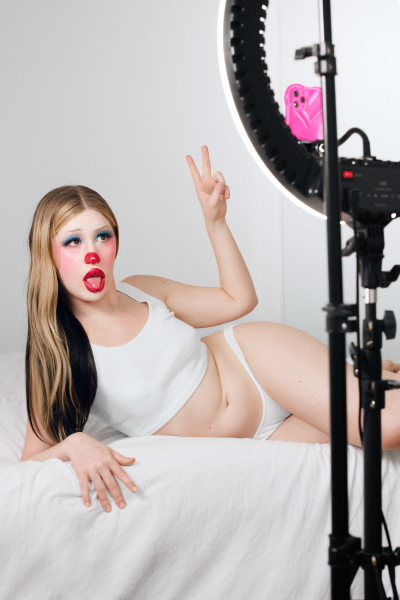
Cash Me Online is a video and photography project in which the author combines performance, selfies, found archive images and deepfakes (the creation and alteration of images through artificial intelligence) to explore the impact of cameras in the age of social media.
The core of the project revolves around the creation of a meticulously crafted hyper-feminine digital alter ego to fully immerse itself in the world of social media.
This digital identity is inspired by other female figures present in the online sphere and aims to be an exploration of female self-representation. The concept of the ‘female gaze’ at a time when women have a prominent presence on screen, representing themselves, contradicts the search for one's own identity and the tension between the standardisation of codes, bodies and the permanence of a single perception of female beauty.
By subverting expectations and introducing elements of unpredictability, Amandine Kuhlma aims to provoke critical thinking about the influence that social media has on self-perception and the social constructs that shape our online experiences.
However, she also highlights the persistence and masked recycling of toxic female stereotypes that have recurred throughout history.
Vanessa Pey
(Spain, 1975)
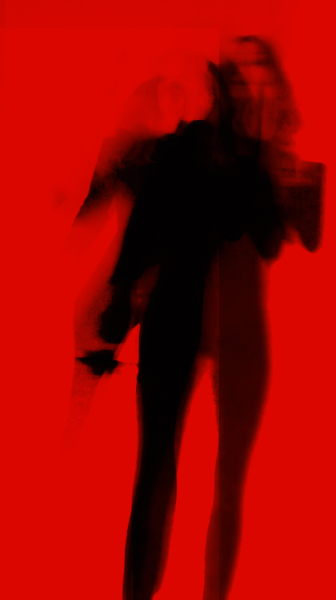
The author freezes the moving image by selecting different frames from a video capture. In this case, stopping time means creating a new time for the images. The tools available to contemporary photographers have expanded beyond the camera. Scanners, screenshots, video recordings, the reinterpretation of archives and the manipulation of digital code are the new avenues of exploration for their eyes.
In her series, Beating Paths, five panel images that function as five screens show us a ghostly approximation of the portrait of the individual. We see a celebration of the glitch, the pixel, the blurriness. There is a lack of temporal and visual anchorage, which makes them disturbing and delirious, almost erotic portraits. Continuing with the celebratory line, it is as if the artist were looking for a way to sensualise the pixel and ambiguity, to enhance their importance and poetic fervour. These fiery and explosive portraits could also be considered pop tributes to a kind of archetype (or deity) of distortion. We see a figure empowered by its distortion. Liquidity is freedom, and the subject of the portraits has it. Neocorporealities and new understandings of gender are also based on the beauty of the queer, which unintentionally breaks with normativity and stability, opting instead for the transient and mutant. The figure is transmuted by the filters and layers with which the artist plays, avoiding existential stillness and, therefore, formal accuracy; in affective or identity terms, the figure could be anyone, opening up space for the insertion of the audience, another layer of eroticism. The artist wants us to kinkily slip into the esoteric, pixelated skin of the figure she presents.
Our identity, our aura emerges when the emphasis is not on our literal visuality, but when it becomes an ambiguous and pixelated mirage. Pey captures and choreographs these fleeting moments, in which facial details and emphasis on gender disappear, and we see the visceral skeleton that underpins us.
Alexander Binder
(Germany, 1976)
Alexander Binder, based in Stuttgart, was born in 1976 in Germany's Black Forest region. He is a self-taught photographer with no formal artistic training. Viewing creation through antique lenses, self-made lenses, prisms and optical toys, he invites the viewer on a psychedelic journey into a universe full of contrasts: colour photographs clash with dense black-and-white works, where life and death, beauty and ugliness confront each other.
Kristall ohne Liebe (literally translated as “Crystal without Love”) is a visual journey into a mystical and dreamlike parallel world.
Attracted by the occult and mysticism, his references are the visionary world of science fiction, fantasy novels, Lovecraftian horror, conspiracy theories and underground comics.
In his work, he likes to play with the well-known and accepted idea that photography is a means of documenting the world, a faithful mirror of reality. The use of this tool to capture invisible and magical planes creates confusion, but also helps to question our perception of the ‘real world’. The screen that separates us from the depths.
The forests and wilderness filled with invisible and dark telluric forces as spaces of the subconscious where the boundary between the environment and the self vanishes is what he wants to show in his images.
For him, photographs are sigils, graphic symbols used in magic as the signature of a spiritual entity. In modern usage, especially in the context of chaos magic, which has followers such as writers Robert Anton Wilson and Allan Moore and the musicians of Die Antwoord, sigils refer to a symbolic representation of the magician's desired outcome.
According to the author, he always hated the clean aesthetics and perfect results of standard lenses. His personal vision of photography led him to pinhole photography, using cheap plastic cameras and old Soviet lenses. His favourite photographic lenses consist only of a small hole in a piece of metallic paper attached to a cover plate.
The designs of his self-built cameras are not really elaborate and seem rather amateurish, full of small, slow features of old cameras loaded with expired colour or black and white film.
An aesthetic practice that shuns pixels and modern digital sensors.
Tatu Gustafsson
(Finland,1979)
The birth of writing is linked to the control of food surpluses in the large urban centres of what is known as the Fertile Crescent and is therefore closely linked to economic and political power. The alphabet was only in the hands of a privileged caste, which soon used writing as a technology for controlling the population.
The emergence of photography was a great scientific and technical milestone with no connection to art. It was only over time that its creative possibilities were discovered. However, as in the case of the alphabet, it became a technology of control, surveillance and punishment. It is worth remembering Alphonse Bertillon's spoken portraits, which were initially used to identify wrongdoers and criminals and later became the national identity card. Today, all citizens carry their police record in their wallets. Recording cameras in public spaces, facial recognition algorithms, and data mining on the social networks of surveillance capitalism form a hyper-panopticon of total control. Of course, they will tell us that it is always for the benefit of our security, and we will go through life happier.
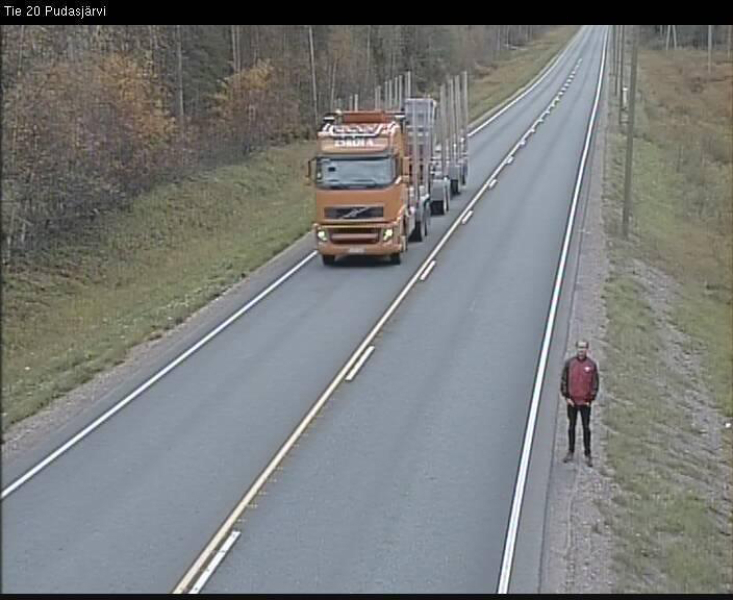
I on the Road/Weather Camera Self-Portraits, Tatu Gustafsson's work consists of 200 self-portraits taken with weather monitoring cameras. Since Gustafsson began taking self-portraits in 2012, he has focused on an alternative approach to photography and has attempted to question the issues of authorship associated with traditional photography. Early on, he discovered that traffic and weather cameras in Finland take a photo every twelve minutes and store it online for 24 hours. Gustafsson embarked on a road trip across the country, positioning himself in front of more than 700 outdoor cameras and accepting the lack of control inherent in this process. The result is haunting images that capture the essence of loneliness and a liberating creative process that plays against the machinery of control.
The title of his series is a nod to Jack Kerouac's legendary Beat Generation novel On the Road, which, with its spontaneous prose and frenetic pace, describes a romantic and bohemian life in 1950s America, where the road trip becomes a symbol of freedom and escape. The car, a machine that has become capital for the enslavement of the wage earner and for the assimilation of capitalist values as a machine of escape and autonomy.
Are images and words our panopticon or the sheets tied to the bars of our cell?
Chloe Azzopardi
(France, 1994)
According to geographer Yi-Fu Tan, the human mind seems predisposed to order phenomena not only into segments, but also into opposing pairs. It shows a definite tendency to distinguish pairs within the segments we perceive in the continuum of nature, and then assign opposite meanings to the components of each pair. This could simply reflect an intimate structure of the human mind that we transfer to the reality around us. Antinomic concepts such as up-down, right-left, here-there stem from the physical reality of our own bodies and serve to order the world from our own perspective. These fundamental oppositions of our human experience take on a symbolic and ontological meaning: life-death, light-darkness, chaos-cosmos, masculine-feminine, nature-civilisation...
Human beings have ceased to see themselves as part of the whole. They view reality from the outside. The very opposition between natural and artificial is misleading: nothing is more artificial—that is, created by humans—than a vegetable garden or a field of crops. And at the same time, nothing is more human than technology.
Science and technology are human creations, and mathematics and physics are not the language of the universe. They are the most objective tools within our intersubjectivity for creating the cosmos and bringing us closer to it.
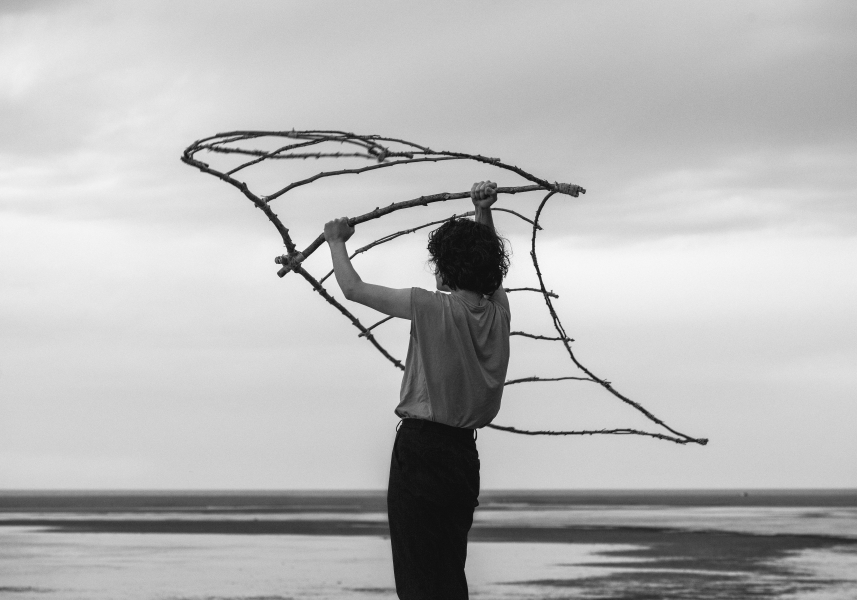
With the series, Non-Technological Devices, Chloe Milos Azzopardi proposes a universe composed of futuristic objects, tools made from collected natural elements, assembled to imitate the technological devices that populate our daily lives. Between rudimentary productions and science fiction creations, these artefacts are a mirror of our fantasies of the future. The artist initiates a reflection on our imagination: how can we envision an alternative future in the face of our dreams of a hyper-artificialised and technologised world? With the help of fiction and play, Azzopardi seeks other ways of imagining augmented lives, creating organic cyborgs whose aim would be to inscribe the body in a different way in the environment. He uses the displacement and poetic diversion of symbolic artefacts of technical progress to question our relationship with living things and with the disappearance of the Earth's “resources” used to build the components of our technological objects.
Katrick Koening
(Germany, 1986)
Koenning and Protick practise photography independently and thousands of miles apart (Katrin Koenning, although born in Germany, is based in Australia, and Sarker Protick in Bangladesh), but they are able to work together on their images thanks to internet connectivity and the ability to send digital files.
Armed with their mobile phones as their preferred photographic tool, they document everyday life impulsively and almost obsessively, sometimes on their doorsteps, often far from home.
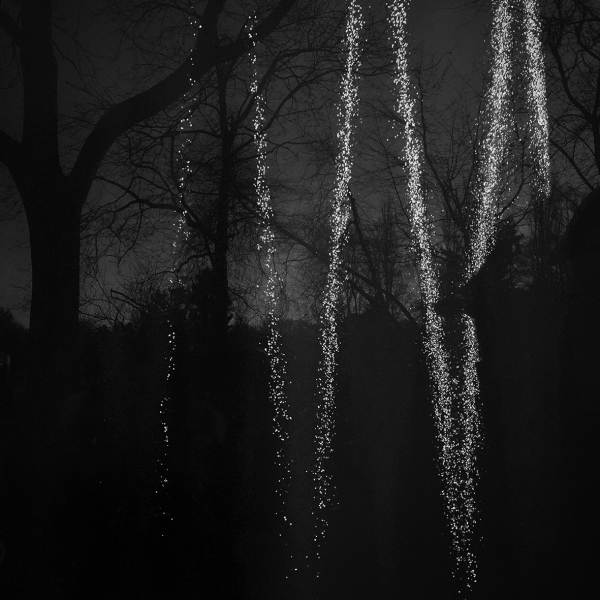
Their devices capture such familiar things as a puddle of water on the asphalt, a cloud of dust, a ray of light, which, through their gaze, are transformed into fascinating elements: imaginary creatures, the Milky Way, a phosphorescent silhouette like an elusive ghost.
Two voices that become one take us on this four-handed journey through unknown territory, between the everyday and the paranormal, between night and day. It is in the depths of the dark darkness that the light is revealed, dazzling and miraculous.
Their work Astres Noirs (black stars) appeared in book form, where digital photographs captured with a mobile phone, some of which had been published - uploaded - on Instagram, are printed in silver ink on deep black matte paper.
The images follow one another in square format, some separated by black pages - the negative of the usual white pages. There are images hidden between the pages bound together in Japanese-style binding. Visible images and hidden images. A contrast between the visible and the hidden, between light and darkness. A continuity between the two photographic works that function as an organic whole.
The images form a black mirror, an opaque screen that invites us to speculate on their meaning. Let us remember that the etymology of speculate means to observe the stars with the help of a mirror. These black stars where, through the lens and his eyes, bird droppings can become a universe, a brilliant cosmic display.
Sarker Protick
( Bangladesh, 1986)
Koenning and Protick practise photography independently and thousands of miles apart (Katrin Koenning, although born in Germany, is based in Australia, and Sarker Protick in Bangladesh), but they are able to work together on their images thanks to internet connectivity and the ability to send digital files.
Armed with their mobile phones as their preferred photographic tool, they document everyday life impulsively and almost obsessively, sometimes on their doorsteps, often far from home.
Their devices capture such familiar things as a puddle of water on the asphalt, a cloud of dust, a ray of light, which, through their gaze, are transformed into fascinating elements: imaginary creatures, the Milky Way, a phosphorescent silhouette like an elusive ghost.
Two voices that become one take us on this four-handed journey through unknown territory, between the everyday and the paranormal, between night and day. It is in the depths of the dark darkness that the light is revealed, dazzling and miraculous.
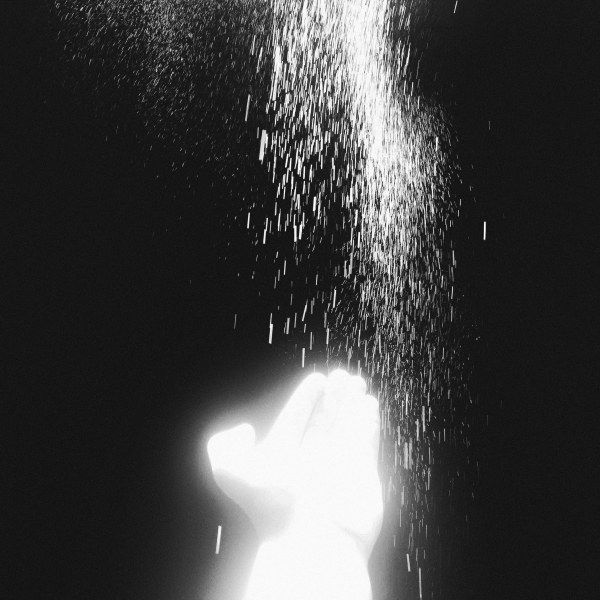
Their work Astres Noirs (black stars) appeared in book form, where digital photographs captured with a mobile phone, some of which had been published - uploaded - on Instagram, are printed in silver ink on deep black matte paper.
The images follow one another in square format, some separated by black pages - the negative of the usual white pages. There are images hidden between the pages bound together in Japanese-style binding. Visible images and hidden images. A contrast between the visible and the hidden, between light and darkness. A continuity between the two photographic works that function as an organic whole.
The images form a black mirror, an opaque screen that invites us to speculate on their meaning. Let us remember that the etymology of speculate means to observe the stars with the help of a mirror. These black stars where, through the lens and his eyes, bird droppings can become a universe, a brilliant cosmic display.
FSA Archives
(USA, 1935-1944)
Showing reality also means hiding part of it. Screens reveal and conceal the world. There is always a hidden part.
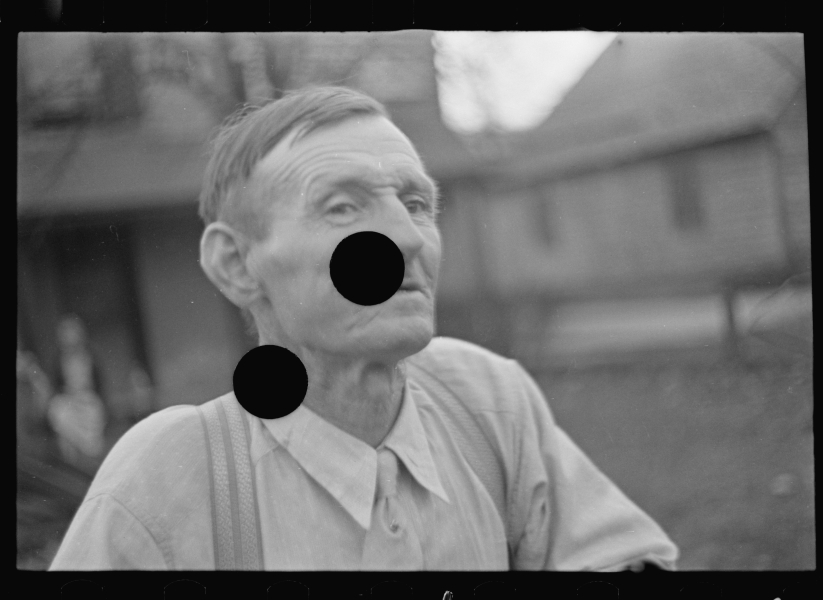
Even our eyes have a blind spot. There is an area of the retina where the optic nerve connects and where there are no photoreceptor cells (cones and rods), so light is not detected and no image is formed. It is a small area where we see nothing, but the brain compensates for or invents this lack of information. A black hole in the middle of our gaze.
The Farm Security Administration (FSA) was a US agency founded as part of President Roosevelt's New Deal policy to combat rural poverty during the Great Depression in the United States.
The FSA was famous for its photography programme from 1935 to 1944, which sought to document the harsh living conditions in rural America. The photographs in the Farm Security Administration/Office of War Information (FSA/OWI) Collection constitute an extensive record of American life between 1935 and 1944. This photography project was directed for most of its existence by Roy Stryker.
Among the photographers who participated in this documentation programme were the renowned Walker Evans, Dorothea Lange and Gordon Parks, among others.
The FSA image collection is the most famous embodiment of a broader movement that crystallised the documentary trend during the 1930s. Indeed, it was at this time that the idea of a documentary genre with its own theory and aesthetics emerged in both photography and cinema.
Of the 270,000 photographs commissioned by the FSA to document the Great Depression, more than a third were discarded.
The images rejected by the project director, Roy Emerson Stryker, were drilled through with a drill to render the negative unusable. Many of these excluded and marked images are preserved in the same archive at the Library of Congress.
Authors and researchers such as Erica X Eisen and Bill McDowell have investigated this hidden legacy to reveal what was not meant to be seen. One America had to be shown in order to cancel out the other side of America.
If we want to examine which images Stryker considered worthy of being saved from the drill, we must also consider which images he considered worthy of photographing in the first place.
The plan was to document the harsh conditions of the cotton fields of Alabama, but at the same time to highlight the heroic resistance of poor Americans who looked to the future with hope. The photographs were intended to reinforce the implementation of the FSA's own policies. The farmers portrayed had to be worthy of receiving state aid, which is why we find that Latinos and Native Americans are underrepresented and that white families are much more prominent than those of African descent.
The photographs were intended to reinforce the implementation of the FSA's own policies. The farmers portrayed had to be worthy of receiving state aid, which is why we find that Latinos and Native Americans are underrepresented and white families are much more prominent than those of African descent.
With the passage of time, the discarded images tell us much more about the history of the Great Depression. The black hole of Stryker's drill has ended up revealing what was meant to be hidden. This exhibition, America and Mr. Stryker's Drill, awakens our awareness of a blind spot in our gaze that should help us gain a deeper insight into things. In the black hole of the negatives live a present time and a past time, and it is our eyes that fill them with light.